Digital Forensic Investigation
Digital Forensic Investigation Overview
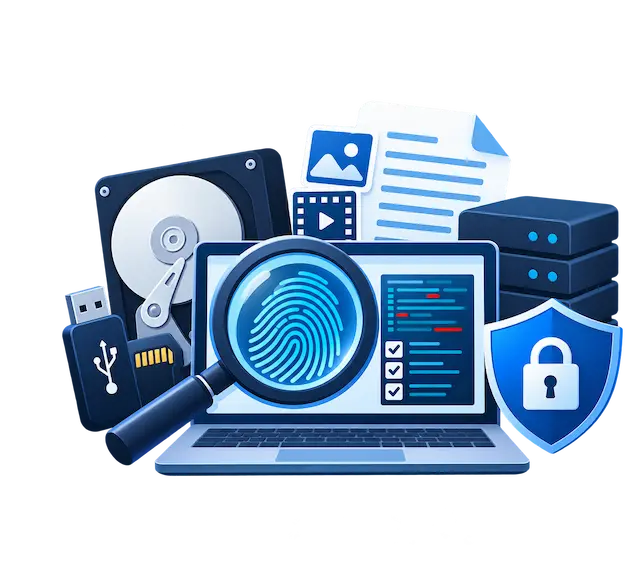
Digital Forensic Investigation involves the collection, preservation, analysis, and reporting of digital evidence following a security incident.
It is designed to answer key questions:
- How did the attacker gain access?
- What systems and data were affected?
- Is the threat still active?
- Was sensitive data exfiltrated?
All investigations are conducted using forensically sound methodologies to ensure evidence integrity.

IDENTIFY
Confirm the Incident
Assess suspicious activity and available indicators to determine the nature, scope, and potential severity of the cybersecurity incident.

ANALYSE
Reconstruct What Happened
Examine and correlate digital evidence to identify the initial attack vector, attacker activity, lateral movement, malware behaviour, compromised accounts, and incident timeline.

PRESERVE
Protect Digital Evidence
Secure and preserve relevant digital evidence using forensically sound methods to maintain its integrity throughout the investigation.
DETERMINE
Establish Impact & Root Cause
Determine the root cause, affected systems and data, potential data exfiltration, and whether malicious activity remains within the environment.

COLLECT
Acquire Relevant Data
Collect evidence from affected endpoints, servers, networks, logs, email systems, and other relevant sources for detailed examination.

RESPOND
Contain, Recover & Strengthen
Provide actionable findings and remediation guidance to help contain threats, support recovery, address security weaknesses, and reduce the risk of recurrence.
Endpoint Forensics • Network Forensics • Log & Event Analysis • Email & Phishing Analysis • Data Breach Analysis
The Needs For Digital Forensics Service
Digital forensics help to ensure the overall integrity and survivability of your network infrastructure. Organisations may need digital forensics in following type of cases:

Intellectual Property theft

Industrial espionage

Employment disputes

Fraud investigations
Forgeries related matters
Bankruptcy investigations
Issues concern with the regulatory compliance
Inappropriate use of the Internet and email in the workplace
Our Digital Forensics covers:
Digital forensics help to ensure the overall integrity and survivability of your network infrastructure. Organisations may need digital forensics in following type of cases:
- Digital Forensics Course
- Computer Forensics
- Data Recovery
- e-Discovery
- Forensics Data Analysis
- Mobile Forensics
Our Digital Forensics include but are not limited to:
Computer Forensics
Computer forensics is a branch of forensic science which deals with the application of investigative analysis techniques on computers in order to retrieve and preserve evidence.
Network Forensics
It is a sub-branch of digital forensics. It is related to monitoring and analysis of computer network traffic to collect important information.
Database Forensics
It is a branch of digital forensics relating to the study and examination of databases and their related metadata.
Mobile Forensics
It mainly deals with the examination and analysis of mobile devices. It helps to retrieve phone and SIM contacts, call logs, incoming, and outgoing SMS/MMS, Audio, videos, etc.
Scope of Investigation
We investigate cybersecurity incidents across six key areas to uncover attacker activity, determine the extent of compromise, and understand the impact on your systems and data.
Endpoint Forensics
- Disk imaging and forensic analysis
- File system examination
- User activity investigation
- Timeline reconstruction
-
Network Forensics
- Network traffic analysis
- Intrusion detection log review
- Lateral movement tracking
- Command-and-control (C2) activity analysis
Log & Event Analysis
- SIEM and system log correlation
- Authentication and access log analysis
- Privilege escalation tracking
- Suspicious activity and anomaly detection
-
Email & Phishing Analysis
- Phishing email investigation
- Email header and payload analysis
- Malicious attachment analysis
- Suspicious link and URL tracing
Malware & Threat Analysis
- Malware detection and investigation
- Malicious file and process analysis
- Persistence mechanism identification
- Indicators of Compromise (IOC) analysis
-
Data Breach Analysis
- Data access and exfiltration tracking
- Identification of affected data
- Sensitive data exposure assessment
- Breach scope and impact analysis
Our Methodology
Identification
Detect and confirm the incident
Preservation
Secure and preserve digital evidence (forensically sound)
Collection
Acquire data from affected systems and sources
Analysis
Examine evidence to determine attack methods and impact
Reporting
Provide detailed findings and timeline
Remediation Support
Recommend actions to contain and prevent future incidents
Key Benefits
- Accurate Root Cause Analysis
Understand exactly how the incident occurred - Faster Incident Containment
Identify active threats and stop further damage - Regulatory Support
Maintain evidence integrity for audits use - Improved Security Posture
Learn from incidents to prevent recurrence - Business Continuity
Minimize operational disruption and recovery time
Frequently Asked Questions (FAQs)
1. What is Digital Forensic Investigation ?
Digital Forensic Investigation is the process of collecting, preserving, analysing, and reporting digital evidence following a cybersecurity incident. It helps determine how an incident occurred, what systems or data were affected, and the extent of the compromise.
2. When should my organisation conduct a Digital Forensic Investigation ?
An investigation should be considered following a suspected or confirmed data breach, ransomware or malware infection, unauthorised access, insider threat, phishing incident, suspicious system activity, or potential data exfiltration.
3. What types of digital evidence can be investigated ?
Depending on the incident, evidence may be collected and analysed from endpoints, servers, network traffic, system and SIEM logs, email systems, user activity, malicious files, and other relevant digital sources.
4. How do you ensure digital evidence is properly preserved ?
We use forensically sound methodologies and controlled evidence-handling procedures to preserve the integrity of digital evidence throughout the collection, analysis, and reporting process.
5. What will we receive after the investigation ?
You will receive a detailed forensic investigation report, executive summary, incident timeline, root cause analysis, evidence documentation, impact assessment, and remediation recommendations to support recovery and strengthen your security posture.
6. Can Digital Forensic Investigation help prevent future incidents ?
Why Choose Condition Zebra
Local cybersecurity expertise backed by experienced investigators, forensically sound methodologies, secure evidence handling, and practical incident response guidance to help organisations uncover the root cause of cyber incidents, understand their impact, and recover with confidence.

Forensically Sound Approach
Conduct investigations using structured forensic methodologies designed to preserve evidence integrity, maintain accurate documentation, and support regulatory, audit, or investigation requirements.

Experienced Investigators
Work with experienced cybersecurity professionals skilled in digital forensics, incident investigation, threat analysis, and evidence examination across complex IT environments.

End-to-End Support
Receive support throughout the investigation lifecycle—from evidence collection and analysis to root cause identification, impact assessment, and remediation guidance.

Confidential & Secure
Protect sensitive business information and digital evidence through strict handling procedures, controlled access, and secure investigation practices throughout the engagement.