
Performance Testing (Stress / Load)
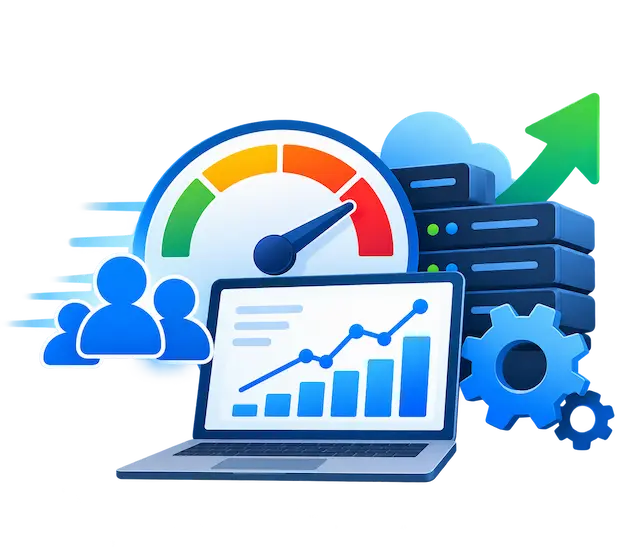
Performance Testing (Stress / Load) Overview
Performance Testing (Stress / Load) evaluates how your applications and infrastructure perform under expected, peak, and extreme workloads. By simulating realistic user activity and monitoring critical performance metrics, we help identify bottlenecks, determine system capacity, validate scalability, and ensure your systems remain stable, responsive, and reliable when demand increases.

PLAN
Define Performance Objectives
Establish testing scope, expected workloads, user volumes, performance requirements, critical transactions, and measurable performance benchmarks.

MONITOR
Measure System Performance
Monitor key metrics including response time, throughput, error rates, concurrent users, CPU, memory, disk, and network utilisation throughout testing.

DESIGN
Create Realistic Workloads
Develop realistic user scenarios and workload models that simulate normal traffic, peak demand, sudden traffic spikes, and extreme operating conditions.
ANALYSE
Identify Bottlenecks & Limits
Analyse test results to uncover application, database, infrastructure, and scalability bottlenecks that could affect performance or system availability.

TEST
Simulate System Demand
Execute load, stress, scalability, and spike testing to evaluate how applications and infrastructure behave under different levels of demand.
OPTIMISE
Improve Performance & Scalability
Provide actionable recommendations to address identified issues, improve system efficiency, strengthen scalability, and support reliable performance during peak demand.
Load Testing • Stress Testing • Scalability Testing
• Spike Testing
Improve Reliability • Identify Bottlenecks • Validate Capacity • Support Scalability • Reduce Downtime
Types of Testing
Load Testing
Simulates expected user traffic to verify system performance under normal conditions.
Focus Areas:
- Response time under typical load
- Throughput and transaction rates
- System stability during business-as-usual operations
Stress Testing
Pushes systems beyond normal capacity to identify breaking points.
Focus Areas:
- Maximum system limits
- Failure behavior and recovery
- System resilience under extreme conditions
Scalability Testing
Evaluates how well your system scales as demand increases.
Focus Areas:
-
- Horizontal and vertical scaling capability
- Resource allocation efficiency
- Performance consistency as users grow
Spike Testing
Simulates sudden surges in traffic.
Focus Areas:
- Handling unexpected traffic spikes
- Auto-scaling effectiveness
- System recovery after surge
Our Methodology
Planning
Define test objectives, scope, and performance benchmarks
Test Design
Create realistic user scenarios and workloads
Test Execution
Run load, stress, and other performance tests
Monitoring
Track system behavior and performance metrics
Analysis
Identify bottlenecks and performance issues
Reporting
Provide detailed results and improvement recommendations
Key Benefits
- Improved System Reliability
Ensure systems remain stable under load - Better User Experience
Deliver fast and responsive applications - Identify Bottlenecks Early
Fix performance issues before production impact - Support Business Growth
Ensure systems scale with increasing demand - Reduce Downtime Risks
Prevent failures during peak periods
Frequently Asked Questions (FAQs)
1. What is Performance Testing (Stress / Load) ?
Performance Testing evaluates the speed, stability, reliability, and scalability of your applications and infrastructure under different workloads. It helps determine whether your systems can maintain expected performance during normal, peak, and extreme demand.
2. What is the difference between Load Testing and Stress Testing ?
Load Testing evaluates system performance under expected and peak user traffic, while Stress Testing pushes the system beyond normal capacity to identify its limits, breaking points, failure behaviour, and ability to recover.
3. What types of Performance Testing do you provide ?
Our assessment can include Load Testing, Stress Testing, Scalability Testing, and Spike Testing, depending on your environment, business requirements, expected traffic patterns, and performance objectives.
4. What performance metrics are measured during testing ?
We monitor key metrics including response time, throughput, error rates, concurrent users, CPU utilisation, memory usage, disk activity, and network utilisation to understand how the system behaves as demand increases.
5. Will Performance Testing affect our production systems ?
Performance Testing is carefully planned to minimise operational risk. The appropriate test environment, workload, timing, and testing limits are agreed upon before execution. Where possible, testing can be conducted in a controlled or staging environment that reflects production conditions.
6. What will we receive after the Performance Testing ?
You will receive a detailed Performance Testing Report covering test results and metrics, identified bottlenecks, system capacity and limitations, benchmark results, and actionable recommendations to improve performance, scalability, stability, and reliability.
Why Choose Condition Zebra
Condition Zebra combines realistic performance testing scenarios, advanced testing techniques, and experienced technical expertise to help organisations understand how their applications and infrastructure perform under real-world demand. Our assessments provide measurable insights and practical recommendations to improve performance, reliability, scalability, and system readiness.

Realistic Testing Scenarios
Simulate real-world user behaviour, expected workloads, peak traffic, sudden spikes, and extreme demand to understand how your systems perform under conditions that reflect actual business usage.
Advanced Tools & Techniques
Apply proven performance testing tools and methodologies to accurately measure response times, throughput, resource utilisation, error rates, system capacity, and scalability across your environment.

Experienced Engineers
Work with experienced engineers who understand application, database, network, and infrastructure performance, helping identify bottlenecks and technical limitations across multiple layers of your systems.

Actionable Recommendations