
Cyber Risk Rating
Turn Cyber Risk Into Clear, Actionable Security Insights.

Cyber Risk Rating Overview
See Your Cyber Risk from an Attacker’s Perspective
Gain continuous visibility into your organisation’s external attack surface, vulnerabilities, security posture, and third-party risks. Cyber Risk Rating provides an independent, outside-in view of your environment, helping you identify exposures, understand their significance, and prioritise action before they can be exploited.

DISCOVER
External Attack Surface
Continuously discover internet-facing assets, exposed systems, domains, IPs, and cloud environments.
PRIORITISE
Risk & Threat Context
Correlate vulnerabilities with real-world threats and prioritise exposures based on severity and likelihood of exploitation.

IDENTIFY
Vulnerabilities & Exposures
Identify vulnerabilities, misconfigurations, open ports, insecure services, and other external security weaknesses.

MONITOR
Continuous Risk Visibility
Track changes in security posture, third-party risks, and performance over time to identify emerging areas of concern.

SCORE
Cyber Risk Rating
Measure your security posture through continuous risk scoring, security ratings, and industry benchmarking.

IMPROVE
Reduce Cyber Risk
Turn risk insights into actionable remediation priorities that help continuously strengthen your organisation’s external security posture.
The Threat Landscape
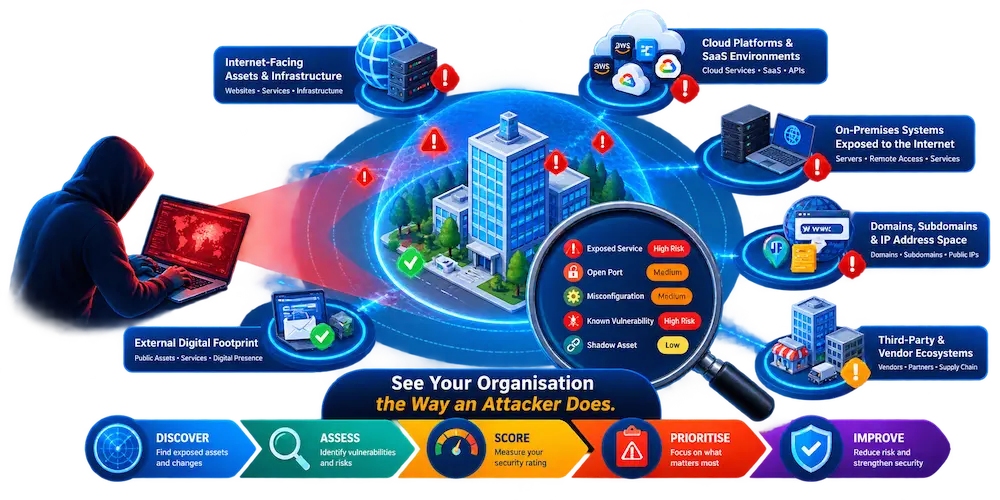
As organisations expand their digital footprint across cloud platforms, internet-facing systems, domains, applications, and third-party ecosystems, their external attack surface continues to grow. New assets, vulnerabilities, misconfigurations, and exposed services can emerge over time, creating security gaps that attackers may discover and exploit before internal teams are aware of them.
Without continuous visibility into external cyber risk, organisations may struggle to understand where they are exposed, which weaknesses pose the greatest risk, and how their security posture is changing. Cyber Risk Rating provides an independent, outside-in view that continuously identifies exposures, measures security posture, monitors third-party risks, and helps organisations prioritise improvements before weaknesses can be exploited.
Attack Surface
INTERNET-FACING ASSETS CAN CREATE HIDDEN EXPOSURE
Unknown & Exposed Assets
Organisations may have internet-facing systems, services, domains, and cloud assets that are unknown or insufficiently secured. Attackers continuously scan external environments for weaknesses that can provide an entry point.
Risk Changes
YOUR SECURITY POSTURE DOESN’T STAY STATIC
Evolving Risk Posture
New assets, vulnerabilities, misconfigurations, and infrastructure changes can alter your organisation’s external risk profile. Cyber Risk Rating continuously identifies these changes, helping security teams understand where new exposures are emerging.
Beyond Your Walls
THIRD-PARTY RISK CAN BECOME YOUR RISK
Supply Chain Exposure
Vendors, suppliers, and other third parties can introduce additional cyber risk. Monitoring their external security posture helps identify higher-risk vendors and provides greater visibility across your broader digital ecosystem.
Risk Score
MEASURE • BENCHMARK
• PRIORITISE • IMPROVE
Cyber Risk Rating
Cyber Risk Rating combines attack surface discovery, vulnerability detection, security ratings, threat intelligence, third-party monitoring, and benchmarking to provide an outside-in view of your security posture and help prioritise the risks that matter most.
Key Cyber Risk Rating Capabilities
1. Discover & Identify Risk
Understand your organisation’s external exposure and identify weaknesses that could be exploited.
🔴 External Attack Surface Visibility
Gain a complete view of your external digital footprint.
-
- Continuous discovery of internet-facing assets
- Identification of exposed systems and services
- Monitoring across domains, IPs, and cloud environments
- Continuous discovery of internet-facing assets
✅ Value: Know what attackers can see and where your organisation may be exposed.
🔴 Vulnerability & Misconfiguration Detection
Identify security weaknesses before attackers exploit them.
-
- Detect outdated systems, open ports, and insecure services
- Identify misconfigurations across public-facing assets
- Prioritise weaknesses based on risk severity
- Detect outdated systems, open ports, and insecure services
✅ Value: Identify and prioritise external security gaps that require attention.
2. Assess & Prioritise Risk
Turn technical findings and threat information into measurable cyber risk.
🔴 Continuous Risk Scoring & Security Ratings
Measure and understand your organisation’s cyber risk posture.
-
- Dynamic risk scoring based on vulnerabilities and exposures
- Industry benchmarking and comparison
- Clear visibility into overall security posture
- Dynamic risk scoring based on vulnerabilities and exposures
✅ Value: Translate complex security data into an understandable measure of cyber risk.
🔴 Threat Intelligence & Risk Insights
Add real-world threat context to security findings.
-
- Correlate vulnerabilities with active threats
- Prioritise risks based on exploitation likelihood
- Gain insight into attacker activity and exposure
- Correlate vulnerabilities with active threats
✅ Value: Focus remediation efforts on risks most relevant to your organisation.
3. Monitor & Benchmark
Continuously track changes across your organisation and third-party ecosystem.
🔴 Third-Party & Supply Chain Risk Monitoring
Understand the cybersecurity posture of vendors and external partners.
-
- Continuously monitor third-party cyber risks
- Identify higher-risk vendors
- Support vendor risk management programmes
- Continuously monitor third-party cyber risks
✅ Value: Improve visibility into cyber risks beyond your own environment.
🔴 Security Posture Trends & Benchmarking
Track security performance and improvement over time.
-
- Historical risk tracking
- Industry and peer benchmarking
- Security performance metrics
- Historical risk tracking
✅ Value: Measure progress and identify areas where security posture needs improvement.
4. Report & Communicate
Turn cyber risk information into clear insights for technical teams and decision-makers.
🔴 Reporting & Executive Visibility
Provide stakeholders with clear visibility into cyber risk.
-
- Executive dashboards and risk summaries
- Detailed technical reports
- Compliance and audit support
- Executive dashboards and risk summaries
✅ Value: Communicate cyber risk clearly and support informed security decisions.
Cyber Risk Rating Coverage

Internet-Facing Assets & Infrastructure
Monitor externally accessible systems, services, and infrastructure to identify exposures, vulnerabilities, and potential security weaknesses.

Third-Party & Vendor Ecosystems
Monitor the external security posture of vendors and third parties to identify potential supply chain and ecosystem risks.

Cloud Platforms & SaaS Environments
Assess externally visible cloud and SaaS environments to identify security risks, misconfigurations, and potential exposure.

Domains, Subdomains & IP Address
Continuously monitor domains, subdomains, and public IP addresses to discover exposed assets and changes across your digital footprint.

On-Premises Systems Exposed to the Internet
Identify and assess on-premises systems that are publicly accessible and may increase your organisation’s external attack surface.

External Digital Footprint
Monitor your organisation’s broader external presence, including publicly exposed digital assets and services, to identify potential security risks and unknown exposures.
Managed Cyber Risk Rating
What Our MSSP Adds on Top of Cyber Risk Rating Technology
Cyber Risk Rating technology provides visibility into your organisation’s external security posture, but visibility alone does not reduce risk. Our MSSP adds expert analysis, continuous validation, risk prioritisation, threat context, and remediation guidance to help your organisation understand which risks matter most, take appropriate action, and continuously improve its security posture.
1. Monitor & Prioritise Risk
Continuously validate cyber risk findings and identify which exposures require the most attention.
🔴 Continuous Risk Monitoring & Validation
Maintain accurate visibility into changes in your organisation’s risk posture.
- Continuously monitor changes in cyber risk
- Validate findings to reduce noise and false positives
- Identify meaningful changes that require attention
✅ Value: Accurate and actionable risk visibility.
🔴 Risk Prioritisation & Remediation Guidance
Focus remediation efforts on risks with the greatest potential impact.
- Prioritise vulnerabilities based on risk and business impact
- Provide clear, actionable remediation guidance
- Help security teams focus resources effectively
✅ Value: Focus on what matters most.
🔴 Threat Context & Intelligence Enrichment
Add real-world threat context to identified exposures.
- Correlate risks with active threats
- Identify exposures more likely to be exploited
- Provide additional context for prioritisation
✅ Value: Better decision-making and faster response.
2. Manage & Improve Security Posture
Extend risk management beyond internal assets and continuously strengthen overall security posture.
🔴 Third-Party Risk Management Support
Gain deeper insight into vendor and supply chain cyber risk.
- Analyse vendor risk beyond raw security scores
- Support vendor assessments and follow-ups
- Help identify higher-risk third parties
✅ Value: Reduced supply chain risk.
🔴 Continuous Security Posture Improvement
Turn cyber risk insights into measurable security improvements.
- Track remediation progress over time
- Identify recurring or persistent risk areas
- Recommend strategies to improve security posture
✅ Value: Continuous and measurable risk reduction.
3. Report & Govern
Translate technical cyber risk into meaningful information for management, compliance, and governance.
🔴 Reporting, Compliance & Governance
Provide clear visibility into cyber risk and remediation progress.
- Executive-level reporting with actionable insights
- Track security posture and risk reduction
- Support audits and compliance requirements
✅ Value: Improved long-term security effectiveness
Cyber Risk Rating Capabilities vs Managed Cyber Risk Rating (MSSP)
Cyber Risk Rating technology helps identify, measure, and monitor your organisation’s external cyber risks. Managed Cyber Risk Rating adds expert analysis, continuous validation, risk prioritisation, and remediation guidance to help turn risk visibility into actionable improvements and measurable risk reduction.
Capability Area
Technology vs MSSP- Primary Role
- Risk Visibility
- Risk Scoring
- Vulnerability Detection
- Threat Intelligence
- Third-Party Risk
- Alerting
- Risk Prioritisation
- Reporting
- Compliance Support
- Operational Responsibility
- Outcome
Option 1
Cyber Risk Rating (Technology)- Provides visibility into external risk posture
- Identifies External Security Risks
- Generates automated security ratings
- Detects misconfigurations and exposures
- Provides basic threat context
- Identifies vendor risk levels
- Generates alerts and notifications
- Limited or automated prioritisation
- Standard dashboards and reports
- Provides data for audits
- Managed by internal teams
- Identifies risks
Option 2
Managed Cyber Risk Rating (MSSP)- ✅ Provides analysis, prioritisation, and risk reduction
- ✅ Validated and continuously monitored risk insights
- ✅ Interprets scores and aligns them to business risk
- ✅ Prioritises and guides remediation efforts
- ✅ Enriched with real-world threat analysis
- ✅ Supports vendor risk management and mitigation
- ✅ Investigates and validates alerts
- ✅ Expert-driven risk prioritisation
- ✅ Executive insights and actionable reporting
- ✅ Helps achieve and maintain compliance readiness
- ✅ Fully managed by MSSP experts
- ✅ Ensures risks are actively reduced
Frequently Asked Questions (FAQs)
1. What is Cyber Risk Rating ?
Cyber Risk Rating provides an independent, outside-in assessment of your organisation’s cybersecurity posture. It continuously evaluates external assets, vulnerabilities, misconfigurations, and other security exposures to provide a measurable view of cyber risk.
2. What does Cyber Risk Rating monitor ?
Cyber Risk Rating monitors your external digital footprint, including internet-facing assets, domains, subdomains, IP addresses, cloud environments, exposed systems, and third-party risks.
3. How is a cyber risk or security rating calculated ?
The technology evaluates factors such as vulnerabilities, external exposures, misconfigurations, and security weaknesses to generate a dynamic risk score or security rating. This helps provide a simplified view of your organisation’s overall external security posture.
4. Can Cyber Risk Rating help monitor third-party and vendor risks ?
Yes. Cyber Risk Rating can continuously monitor the external security posture of vendors and third parties, helping identify higher-risk organisations and support vendor and supply chain risk management programmes.
5. How does Cyber Risk Rating help improve our security posture ?
It helps organisations identify external weaknesses, prioritise risks, track security posture over time, and benchmark performance. These insights enable security teams to focus remediation efforts on areas that can meaningfully reduce cyber risk.
6. What is the difference between Cyber Risk Rating and Managed Cyber Risk Rating (MSSP) ?
Cyber Risk Rating technology primarily identifies, scores, and monitors external cyber risks. Managed Cyber Risk Rating adds expert validation, threat context, risk prioritisation, remediation guidance, third-party risk support, and ongoing optimisation to help turn risk visibility into measurable security improvement.
Why Choose Condition Zebra
Local cybersecurity expertise backed by continuous cyber risk visibility, expert risk analysis, actionable remediation guidance, and ongoing security posture improvement to help your organisation identify and reduce external cyber risks.

Cyber Risk Expertise
Experienced cybersecurity professionals helping your organisation understand external exposures, vulnerabilities, security ratings, and potential areas of cyber risk.

Continuous Risk Visibility
Ongoing monitoring of your external attack surface, vulnerabilities, exposed assets, third-party risks, and changes in your overall security posture.

Risk Prioritisation
Cut through the noise by identifying and prioritising exposures based on severity, threat context, and potential business impact.

Actionable Risk Reduction
Turn cyber risk insights into practical remediation priorities that help reduce exposure and continuously strengthen your organisation’s security posture.

Trusted Security Partner