Cybersecurity
Awareness & Training
Build a Security-Aware Workforce. Strengthen Your Human Firewall.
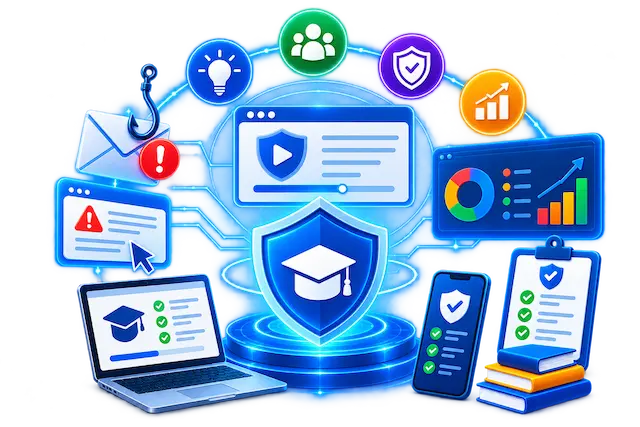
Cybersecurity Awareness & Training Overview
Train Your People. Reduce Human Risk. Strengthen Your Defence.
Cybersecurity Awareness & Training combines continuous security education, realistic phishing simulations, behavioural reinforcement, and human risk analytics to help employees recognise cyber threats, make safer decisions, and become an active line of defence against phishing, social engineering, credential theft, and other human-driven attacks.

EDUCATE
Security awareness training
MEASURE
Human risk scoring

SIMULATE
Realistic phishing simulations

ENGAGE
Phishing reporting & participation

REINFORCE
Real-time user coaching

IMPROVE
Continuous training optimization
Threats Targeting Employees
-
Phishing
Deceptive emails and messages -
Social Engineering
Manipulation and impersonation -
Credential Theft
Attempts to steal login information -
Ransomware
Malicious actions triggered by users -
Human Error
Unsafe clicks and security mistakes
Business Outcomes
-
Threat Recognition
Identify suspicious activity earlier -
Phishing Resilience
Reduce susceptibility to phishing -
Secure Behaviour
Encourage safer everyday actions -
Threat Reporting
Increase employee participation -
Human Risk Visibility
Identify higher-risk users and areas -
Compliance Readiness
Track training and demonstrate awareness
The Threat Landscape
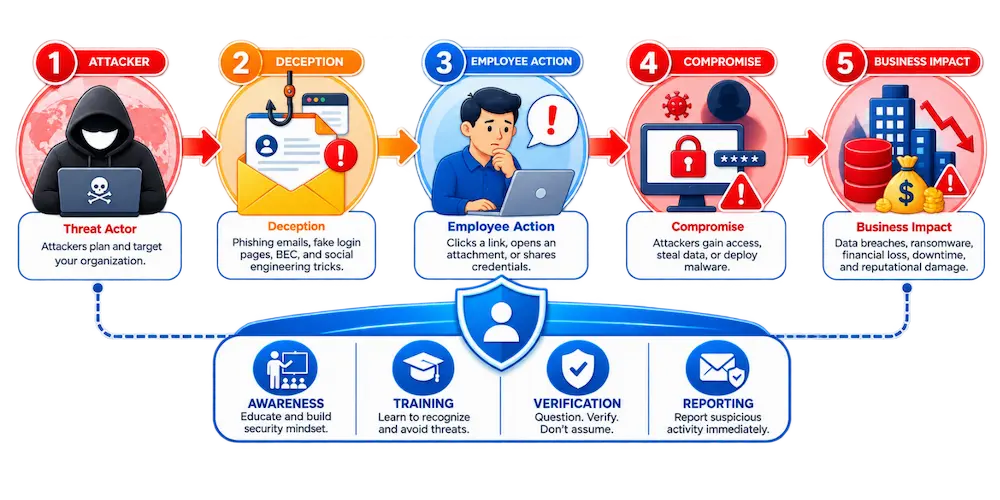
Employees remain a common target for cyberattacks because attackers know that human behaviour can provide a path around technical security controls. Phishing, Business Email Compromise (BEC), social engineering, credential harvesting, malicious links, and ransomware increasingly rely on convincing users to click, respond, disclose information, or take unsafe actions.
Without continuous cybersecurity awareness and practical training, employees may struggle to recognise sophisticated attacks and respond appropriately when targeted. Cybersecurity Awareness & Training combines ongoing education, realistic phishing simulations, behavioural reinforcement, and human risk management to help employees recognise threats, develop safer security habits, report suspicious activity, and become an active line of defence against human-driven cyber risks.
People Are the Target
ATTACKERS EXPLOIT HUMAN TRUST AND BEHAVIOUR
Human-Centred Attacks
Phishing, social engineering, Business Email Compromise, credential harvesting, and malicious links are designed to manipulate employees into taking unsafe actions. A single click, response, or credential submission can create an opportunity for attackers to bypass security controls.
Continuous
SECURITY AWARENESS & PHISHING SIMULATION
Ongoing Security Education
Cybersecurity awareness should not be a one-time exercise. Continuous training, realistic phishing simulations, and threat-based learning help employees recognise evolving attack techniques and practise how to respond safely when targeted.
Behaviour Matters
AWARENESS ALONE DOESN’T CHANGE BEHAVIOUR
Building Safer Security Habits
Effective awareness goes beyond completing training. Real-time coaching, behavioural reinforcement, phishing reporting, and risk-based learning help employees turn cybersecurity knowledge into safer everyday actions.
Continuous
HUMAN RISK REDUCTION & IMPROVEMENT
Cybersecurity Awareness & Training
Cybersecurity Awareness & Training combines continuous education, phishing simulations, behavioural reinforcement, human risk analytics, threat-based content, and measurable reporting to reduce human risk and transform employees into an active line of defence against cyber threats.
Key Cybersecurity Awareness & Training Capabilities
1. Educate & Build Awareness
Build practical cybersecurity knowledge and keep employees informed about evolving threats.
🔴 Security Awareness Training Programs
Engaging and continuously updated cybersecurity education.
-
- Interactive training modules, videos, and simulations
- Role-based and risk-based learning paths
- Multi-language content for diverse teams
✅ Value: Builds strong security fundamentals and improves organisation-wide awareness.
🔴 Threat-Based Training Content
Keep training relevant to real-world cyber risks.
-
- Content aligned with emerging threats
- Phishing, ransomware, social engineering, and insider risk topics
- Practical, scenario-based learning
✅ Value: Keeps employees prepared for threats they are more likely to encounter.
2. Test & Reinforce Behaviour
Put employee awareness into practice and reinforce secure behaviour when it matters.
🔴 Phishing Simulation & Testing
Test employee resilience using realistic phishing scenarios.
-
- Automated phishing simulation campaigns
- BEC, credential harvesting, and spear-phishing scenarios
- Track click, reporting, and user-risk rates
- Automated phishing simulation campaigns
✅ Value: Identifies vulnerable users and strengthens resistance to phishing.
🔴 Real-Time User Coaching & Behavioural Reinforcement
Turn risky actions into immediate learning opportunities.
-
- Real-time warnings during risky email or web activity
- Immediate contextual feedback
- Continuous reinforcement of secure behaviours
- Real-time warnings during risky email or web activity
✅ Value: Encourages lasting behavioural change and reduces repeat mistakes.
🔴 Phish Reporting & User Engagement Tools
Empower employees to become an active security layer.
-
- One-click phishing reporting
- Encourage vigilance and employee participation
- Support earlier identification of suspicious emails
- One-click phishing reporting
✅ Value: Transforms employees from potential targets into proactive defenders.
3. Automate & Manage Human Risk
Use automation and analytics to focus training where it can have the greatest impact.
🔴 Human Risk Scoring & Analytics
Measure cybersecurity risk at individual and organisational levels.
-
- Individual and organisational risk scoring
- Identify higher-risk users and departments
- Data-driven insights for targeted intervention
✅ Value: Enables prioritised risk reduction and more focused training.
🔴 Automated Training Campaigns
Simplify ongoing awareness programme management.
-
- Automated training and simulation scheduling
- Adaptive learning based on behaviour and risk
- Continuous education aligned with evolving threats
✅ Value: Improves efficiency while maintaining consistent employee training.
4. Measure, Report & Demonstrate Compliance
Track programme effectiveness and provide visibility to management, auditors, and stakeholders.
🔴 Reporting & Program Visibility
Measure awareness performance and improvement over time.
-
- Executive dashboards and reports
- User performance and risk-reduction metrics
- Campaign tracking and benchmarking
✅ Value: Provides measurable outcomes and visibility into programme effectiveness.
🔴 Compliance & Audit Support
Support cybersecurity awareness governance and audit requirements.
-
- Training aligned with relevant standards and requirements
- Audit-ready training records and reporting
- Evidence of cybersecurity awareness activities
✅ Value: Simplifies audits and helps demonstrate compliance.
Cybersecurity Awareness Coverage

Employees & General Users
Build cybersecurity awareness across your workforce with practical training that helps employees recognise phishing, social engineering, malicious links, and other common cyber threats.

Endpoints & User Devices
Deliver accessible security awareness and behavioural reinforcement across desktops, laptops, mobile devices, and other user endpoints.

High-Risk Users & Departments
Provide targeted, risk-based training for users, roles, and departments that demonstrate higher levels of human cyber risk or require additional security awareness.

Remote & Hybrid Workforce
Maintain consistent cybersecurity awareness for employees working remotely, in hybrid arrangements, or across multiple locations through scalable training programmes.

Email & Collaboration Environments
Strengthen employee resilience against phishing, Business Email Compromise, credential harvesting, and other email-based attacks through realistic simulations and reporting tools.

Organisation-Wide Security Culture
Build a stronger security culture through continuous education, phishing simulations, user engagement, and measurable improvement that encourages employees to become active participants in cyber defence.
Managed Cybersecurity Awareness
What Our MSSP Adds on Top of Cybersecurity Awareness Platforms
We transforms awareness tools into a fully managed human risk-reduction program — ensuring your users are not just trained but continuously improving as part of your security defence.
1. Manage & Deliver
Build and operate an ongoing cybersecurity awareness programme without adding workload to your internal team.
🔴 Continuous Awareness Program Management
We design, manage, and optimise your awareness programme end-to-end.
- Structure ongoing training campaigns
- Schedule and manage training and simulations
- Maintain consistent engagement across users
✅ Value: A fully operational awareness programme without the internal overhead.
🔴 Advanced Phishing Simulation & Campaign Design
Deliver realistic simulations based on evolving attack techniques.
- Customise scenarios based on real-world threats
- Adjust difficulty according to user maturity
- Target departments, roles, or higher-risk users
✅ Value: More effective training that reflects real-world phishing threats.
2) Monitor & Reduce Human Risk
Identify where human risk exists and focus training and intervention where it matters most.
🔴 Human Risk Monitoring & User Segmentation
Understand individual, departmental, and organisation-wide human risk.
- Identify higher-risk users based on behaviour
- Segment users by risk, role, or department
- Track improvements over time
✅ Value: Focused risk reduction for users who need it most.
🔴 Real-Time User Engagement & Behaviour Reinforcement
Turn employee actions into opportunities for continuous learning.
- Reinforce secure behaviour through ongoing engagement
- Guide users following risky actions
- Encourage active reporting of suspicious activity
✅ Value: Measurable improvement in security awareness and user behaviour.
3. Respond & Continuously Improve
Use real incidents, employee behaviour, and threat trends to continuously strengthen the programme.
🔴 Phishing Incident Handling & User Reports
Help manage suspicious emails reported by employees.
- Review and triage reported phishing emails
- Provide feedback to improve reporting accuracy
- Use findings to strengthen future training campaigns
✅ Value: Faster handling of reported threats and a stronger human defence layer.
🔴 Continuous Program Optimisation
Keep awareness activities relevant as threats and user behaviour evolve.
- Adjust campaigns based on performance and threat trends
- Refine training based on identified weaknesses
- Reduce training fatigue while maintaining engagement
✅ Value: An awareness programme that remains relevant and effective over time.
4. Measure & Demonstrate
Provide clear visibility into programme performance, risk reduction, and compliance.
🔴 Reporting, Insights & Measurable Outcomes
Understand how your awareness programme is performing.
- Executive-level risk and performance reporting
- User behaviour, phishing resilience, and engagement metrics
- Continuous tracking of improvement and programme effectiveness
✅ Value: Demonstrable evidence of cybersecurity awareness improvement.
🔴 Compliance & Audit Support
Maintain the training records and evidence needed for governance and audits.
- Monitor training completion
- Provide audit-ready reports and evidence
- Align programmes with relevant standards and requirements
✅ Value: Simplified compliance and reduced audit burden.
Cybersecurity Awareness vs Managed Cybersecurity Awareness (MSSP)
Cybersecurity Awareness technology provides training, phishing simulations, user risk analytics, and reporting tools to help employees recognise and respond to cyber threats. Managed Cybersecurity Awareness (MSSP) adds cybersecurity experts who continuously manage training programmes, design realistic phishing campaigns, analyse human risk and user behaviour, target higher-risk users, optimise training based on performance, and provide ongoing reporting—turning awareness technology into a proactive, measurable human risk reduction programme.
Capability Area
Technology vs MSSP- Primary Role
- Security Awareness Training
- Phishing Simulation
- User Engagement
- Human Risk Identification
- Behavior Change
- User Segmentation
- Phish Reporting Tools
- Real-Time User Guidance
- Campaign Management
- Program Optimisation
- Threat Alignment
- Audit & Compliance
- Reporting & Visibility
- Operational Responsibility
- Outcome
Option 1
Cybersecurity Awareness (Technology)- Training tools & platforms
- Delivers training content
- Automated phishing simulations
- Users complete training
- Risk scoring & reporting
- Content & feedback
- Basic grouping
- Reporting button/tools
- Alerts & prompts
- Manual setup
- Periodic updates
- General templates
- Tracking & reporting
- Dashboards & metrics
- Internal IT / HR
- Awareness tools
Option 2
Managed Cybersecurity Awareness (MSSP)- ✅ Managed program & continuous improvement
- ✅ Managed program design & optimisation
- ✅ Customised attack-aligned campaigns
- ✅ Continuous engagement & tracking
- ✅ Targeted improvement actions
- ✅ Measurable behavioural improvement
- ✅ Advanced risk & role-based segmentation
- ✅ Managed triage & response
- ✅ Continuous coaching & reinforcement
- ✅ Fully managed campaigns
- ✅ Continuous optimisation & tuning
- ✅ Aligned to current threats & tactics
- ✅ Compliance readiness & audit support
- ✅ Executive insights & risk tracking
- ✅ Fully managed by MSSP
- ✅ Reduced human risk & active defence
Frequently Asked Questions (FAQs)
1. What is Cybersecurity Awareness & Training ?
Cybersecurity Awareness & Training is a continuous programme designed to help employees recognise cyber threats, understand security risks, and develop safer behaviours. It combines security education, phishing simulations, real-time engagement, and human risk management to strengthen your organisation’s human layer of defence.
2. What cybersecurity threats does the training cover ?
Training can address common human-focused threats including phishing, spear phishing, Business Email Compromise (BEC), social engineering, credential harvesting, ransomware, malicious links, insider risks, and data leakage caused by human error.
3. Does the programme include phishing simulations ?
Yes. Realistic phishing simulations can test how employees respond to scenarios such as BEC, credential harvesting, and spear phishing. Results such as click rates, reporting rates, and user risk levels can then be used to identify areas requiring additional training.
4. Can training be tailored to different users and risk levels ?
Yes. Training can use role-based and risk-based learning paths, while human risk analytics can identify higher-risk users or departments. This enables more targeted training and intervention instead of applying the same programme to every employee.
5. How do you measure whether cybersecurity awareness training is effective ?
Programme effectiveness can be measured through phishing simulation results, user risk scores, training completion, reporting behaviour, engagement metrics, campaign performance, and benchmarking. Dashboards and reports provide visibility into employee performance and risk reduction over time.
6. What is the difference between Cybersecurity Awareness & Training and Managed Cybersecurity Awareness ?
Cybersecurity Awareness platforms provide tools for training, simulations, reporting, and user engagement. Managed Cybersecurity Awareness adds expert-led programme management, customised phishing campaigns, human risk monitoring, user segmentation, behavioural reinforcement, programme optimisation, and ongoing reporting—helping turn awareness activities into a continuous human risk-reduction programme.
Why Choose Condition Zebra
Local cybersecurity expertise backed by continuous security awareness, realistic phishing simulations, human risk management, behavioural reinforcement, and trusted security practices.

Security Expertise
Experienced cybersecurity professionals helping your organisation build a security-aware workforce through practical training, simulations, and ongoing human risk reduction.

Continuous Awareness
Ongoing cybersecurity education and phishing simulations keep employees informed about evolving threats, attack techniques, and security risks beyond one-time annual training.

Behavioural Improvement
Real-time coaching, targeted training, and continuous reinforcement help employees recognise risky situations, make safer decisions, and develop stronger security habits over time.

Human Risk Reduction
Identify higher-risk users and departments through phishing simulations, behavioural insights, and human risk analytics, enabling targeted training where improvement is needed most.

Trusted Security Partner
Local expertise and ongoing support tailored to your organisation’s workforce, helping you manage awareness programmes, strengthen phishing resilience, reduce human risk, and build a stronger security culture.