Managed Detection & Response (MDR)
Detect, Investigate and Respond to Cyber Threats Across Your Entire Environment.
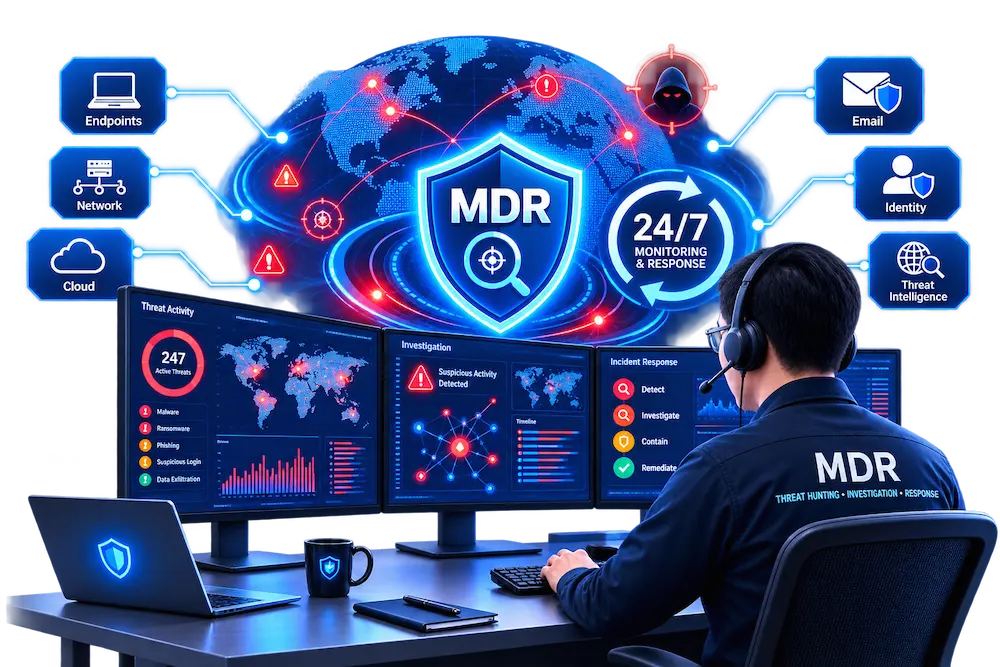
Managed Detection & Response Overview
Detect Threats Faster. Respond with Confidence.
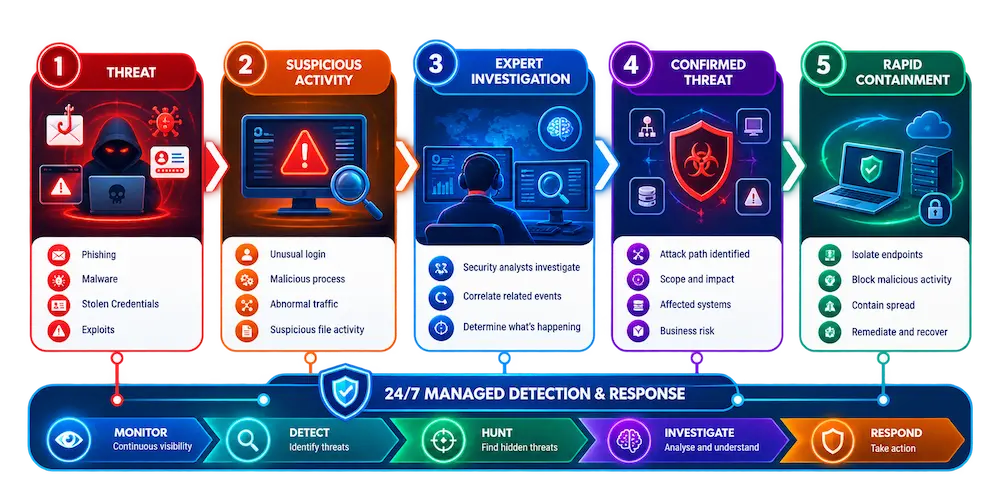
24/7 Managed Detection and Response that continuously monitors, detects, investigates, and responds to cyber threats across endpoints, networks, cloud, identity, and other critical environments to contain attacks before they impact your business.

24/7 MONITORING
Continuously monitor security activity

THREAT HUNTING
Proactively uncover hidden threats
THREAT DETECTION
Identify suspicious activity
INVESTIGATION
Understand attack path, scope & impact
THREAT CORRELATION
Connect related security signals
RAPID RESPONSE
Contain and remediate active threats
Security Environment
- Endpoints
- Network
- Cloud
- Identity
- Security Intelligence
Business Outcomes
- Faster Detection
- Rapid Containment
- Reduced Alert Fatigue
- Lower Operational Burden
The Threat Landscape
Cyber threats are becoming more persistent, sophisticated, and difficult to detect. Attackers increasingly use a combination of phishing, stolen credentials, malware, ransomware, and legitimate system tools to gain access and remain hidden within an organisation’s environment.
Traditional security tools alone may generate alerts, but identifying which activities represent a genuine threat requires continuous monitoring, investigation, and expert analysis. Managed Detection & Response (MDR) provides the 24/7 visibility and expertise needed to uncover suspicious activity, investigate threats, and respond quickly before an incident escalates into wider business disruption.
83%
OF ORGANISATIONS EXPERIENCE MORE THAN ONE CYBER INCIDENT PER YEAR
Continuous Cyber Threats
Cybercriminals use phishing, ransomware, credential theft, and other advanced attack techniques to compromise organisations of all sizes. Continuous monitoring is essential to detect and stop threats early.
16 Days
AVERAGE TIME TO CONTAIN A SECURITY INCIDENT WITH MODERN DETECTION & RESPONSE
Rapid Threat Detection
Attackers can move quickly once inside a network. Managed Detection & Response continuously monitors your environment, identifies suspicious activity, and enables rapid containment before threats escalate.
24/7
SECURITY OPERATIONS CENTRE (SOC) MONITORING
Expert-Led Threat Hunting
Our cybersecurity analysts proactively hunt for hidden threats, investigate alerts, and validate suspicious activities around the clock, reducing alert fatigue and improving security outcomes.
24/7
CONTINUOUS DETECTION, INVESTIGATION & RESPONSE
Managed Detection & Response
Managed MDR combines advanced threat detection, continuous monitoring, expert investigation, and rapid incident response to protect your endpoints, networks, cloud, and users from evolving cyber threats.
Key Managed Detection & Response (MDR) Capabilities
1. Detect & Understand
Continuously monitor your environment and turn security signals into meaningful threat intelligence.
🔴 24/7 Threat Monitoring & Detection
Always-on monitoring across your entire environment.
-
- Continuous analysis of endpoint, network, cloud, and identity signals
- Real-time threat detection using behavioral analytics
- Immediate identification of suspicious activities
- Continuous analysis of endpoint, network, cloud, and identity signals
🔴 Threat Correlation & Contextual Analysis
See the full attack picture — not just isolated alerts.
-
- Correlate data across multiple security controls
- Detect attack patterns and coordinated threats
- Reduce noise and prioritise critical incidents
- Correlate data across multiple security controls
🔴 Integrated Threat Intelligence
Enhance detection with real-world threat insights.
-
- Continuously enriches alerts with threat intelligence
- Maps activity to attacker tactics and techniques
- Improves detection accuracy and prioritization
- Continuously enriches alerts with threat intelligence
2. Investigate & Respond
Go beyond automated alerts to uncover threats, understand incidents, and rapidly contain attacks.
🔴 Advanced Threat Hunting
Proactively identify hidden and emerging threats.
-
- Search for indicators of compromise (IOCs)
- Investigate anomalous and suspicious behaviour
- Detect threats that bypass automated tools
- Search for indicators of compromise (IOCs)
🔴 Incident Investigation & Root Cause Analysis
Understand what happened, how it happened, and the potential impact.
- Conduct deep investigation of security incidents
- Identify attack paths and initial entry points
- Determine the scope and impact of compromise
🔴 Rapid Response & Threat Containment
Stop threats before they spread.
-
- Isolate and contain compromised endpoints
- Block malicious activity and unauthorised access
- Coordinate response across affected systems
- Isolate and contain compromised endpoints
🔴 Automated Response & Orchestration
Accelerate response and reduce attacker dwell time.
-
- Automate containment and remediation workflows
- Integrate response actions with security controls
- Enable immediate action against high-risk events
3. Strengthen & Improve
Continuously enhance detection and response effectiveness as your environment and the threat landscape evolve.
🔴 Continuous Security Optimisation
Improve detection and response over time.
-
- Fine-tune detection rules and security policies
- Adapt controls to evolving threats
- Continuously strengthen your security posture
- Fine-tune detection rules and security policies
Integrated With Your Existing
Security Environment

Endpoints
Laptops, Desktops & Servers

Email & Collaboration Systems
Email Platforms & Communication Tools
Network Infrastructure & Traffic
Firewalls, Network Devices & Traffic Data

Identity & Access Environments
Users, Authentication & Access Systems
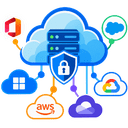
Cloud Platforms & SaaS Applications
Cloud Workloads, Services & Applications

Security Tools & Threat Intelligence
Existing Security Controls, Alerts & Threat Intelligence Feeds
Managed Detection & Response (MDR)
What Our MSSP Adds on Top of Detection & Response Technology
We deliver a fully managed detection and response service, combining security technology with 24/7 expert monitoring, threat hunting, investigation, containment, and rapid response to turn security alerts into actionable protection.
1. Monitor & Analyse
Continuous expert oversight to identify genuine threats and understand their context.
🔴 24/7 SOC Operations
Dedicated security analysts continuously monitor your environment and investigate security alerts.
✅ Value: No missed threats and faster investigation.
🔴 Reduced Alert Fatigue
Filter false positives and low-risk alerts, escalating incidents that require attention.
✅ Value: Focus on what matters.
🔴 Expert-Led Threat Intelligence & Analysis
Apply real-world threat intelligence and expert analysis to provide greater context to detections.
✅ Value: Better detection accuracy and faster decision-making.
2) Respond & Resolve
Move quickly from detection to investigation, containment, and remediation.
🔴 End-to-End Threat Handling
Manage the complete incident lifecycle from detection and investigation through response and remediation.
✅ Value: Complete lifecycle coverage.
🔴 Faster Response Times
Take rapid containment and response actions to limit attacker activity and reduce dwell time.
✅ Value: Reduced business impact.
3. Optimise & Strengthen
Use ongoing monitoring and incident insights to continuously improve security effectiveness.
🔴 Proactive Security Posture Improvement
Continuously tune detection and response processes and apply lessons learned from security incidents.
✅ Value: Stronger defences over time.
Detection & Response Technology vs Managed Detection & Response (MSSP)
Detection and response technology provides continuous threat monitoring, detection, investigation, and response capabilities across your security environment. Our MSSP adds 24/7 security experts who proactively hunt for threats, investigate incidents, rapidly contain attacks, coordinate remediation, and continuously optimise detection and response capabilities.
Capability Area
MDR vs MSSP- Primary Role
- Threat Monitoring
- Threat Detection
- Threat Correlation
- Threat Hunting
- Alert Handling
- Incident Response
- Threat Intelligence
- Policy Management
- Reporting
- Operational Responsibility
- Outcome
Option 1
Detection & Response (Technology)- Detects & correlates threats
- Tool-based monitoring & alerts
- Identifies suspicious activity
- Automated correlation
- Limited/manual
- Generates alerts
- Basic/automated response
- Built-in intelligence feeds
- Configurable rules
- Standard dashboards
- Internal teams
- Detects threats
Option 2
Managed Detection & Response (MSSP)- ✅ Full monitoring, investigation & response
- ✅ 24/7 SOC-led monitoring
- ✅ Validates & investigates threats
- ✅ Advanced + expert analysis
- ✅ Proactive continuous hunting
- ✅ Investigates, filters & prioritises
- ✅ Full response & containment
- ✅ Enriched with real-world expertise
- ✅ Continuous tuning & optimisation
- ✅ Executive & actionable reporting
- ✅ Fully MSSP-managed
- ✅ End-to-end threat handling
Frequently Asked Questions (FAQs)
1. What is Managed Detection & Response (MDR) ?
MDR is a managed cybersecurity service that combines 24/7 threat monitoring, advanced detection technology, expert investigation, threat hunting, and rapid incident response. It helps organisations detect, understand, and contain cyber threats before they cause significant business impact.
2. How is MDR different from traditional security tools ?
Traditional security tools primarily provide visibility, detections, and alerts that still require internal teams to investigate and respond. MDR adds 24/7 security experts who validate alerts, investigate threats, prioritise incidents, and coordinate response and remediation on your behalf.
3. What types of threats can MDR detect and respond to ?
MDR can help identify advanced persistent threats (APTs), ransomware, malware, phishing, credential theft, account compromise, lateral movement, insider threats, data exfiltration, and unknown or zero-day attack techniques.
4. What security environments can MDR monitor ?
MDR can provide visibility across multiple security environments, including endpoints, network infrastructure, cloud and SaaS applications, email and collaboration systems, and identity and access environments.
5. What happens when MDR detects a security threat ?
Security analysts investigate suspicious activity, correlate related events, determine the attack path, scope, and impact, and take appropriate containment and response actions. Depending on the incident and integrated controls, this can include endpoint isolation, blocking malicious activity, and coordinated remediation.
6. Do we still need an internal IT or security team if we use MDR ?
MDR is designed to reduce the operational burden on internal teams by providing dedicated security analysts and end-to-end threat handling. The service manages continuous monitoring, investigation, threat hunting, containment, and response, allowing your internal team to focus on broader IT and business priorities.
Why Choose Condition Zebra
Local cybersecurity expertise backed by 24/7 threat monitoring, expert-led threat hunting, continuous investigation, rapid containment, and coordinated incident response.

Security Expertise
Experienced cybersecurity professionals detecting, investigating, and responding to threats across your security environment.

24/7 Monitoring
Continuous monitoring across endpoints, networks, cloud, email, identity, and other critical environments to identify suspicious activity and emerging threats.

Rapid Response
Faster investigation, containment, and remediation to stop active threats and minimise business impact.

Proactive Protection
Proactively hunt, detect, investigate, and contain ransomware, malware, credential compromise, lateral movement, and advanced threats before they escalate.

Trusted Security Partner