Social Engineering Testing
Social Engineering Testing Overview
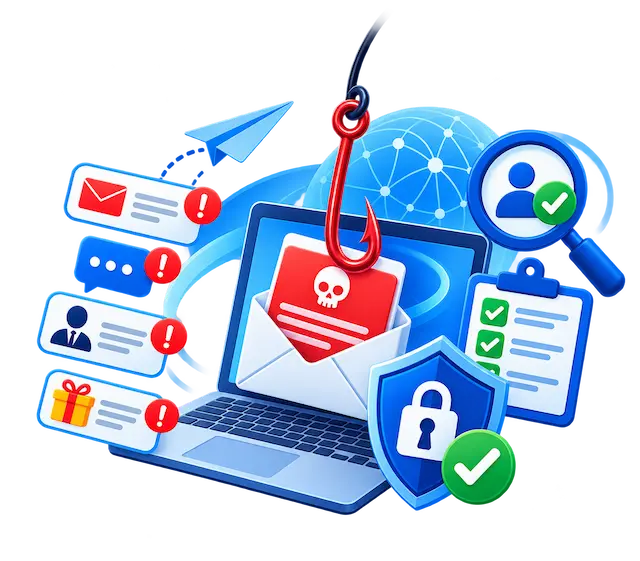
Social Engineering Testing evaluates how employees respond to real-world manipulation and deception techniques across email, voice, messaging, digital, and physical channels. Condition Zebra conducts controlled simulations to identify human vulnerabilities, measure security behaviour, uncover weaknesses in verification processes, and provide actionable insights to strengthen your organisation’s security awareness and resilience.

PLAN
Define Scenarios & Objectives
Design realistic social engineering scenarios based on your organisation’s industry, threat profile, employees, and testing objectives.
MONITOR
Track User Behaviour
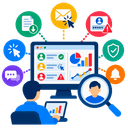
Measure how employees interact with simulated attacks, including clicks, responses, information disclosure, credential submissions, reporting behaviour, and other defined actions.

TARGET
Identify User Groups
Select relevant departments, roles, or employee groups such as Finance, HR, IT, management, and customer-facing teams for assessment.
ANALYSE
Measure Human Risk
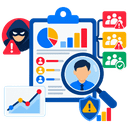
Analyse campaign results to identify vulnerable behaviours, successful attack techniques, high-risk departments, and weaknesses in existing security processes.
SIMULATE
Launch Realistic Attacks
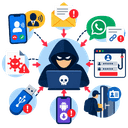
Conduct controlled simulations using phishing emails, vishing calls, WhatsApp messages, credential harvesting, malicious files, USB scenarios, fake applications, or physical techniques where applicable.

STRENGTHEN
Improve Awareness & Resilience
Provide actionable recommendations, targeted awareness insights, and process improvements to help employees recognise, verify, report, and respond to social engineering threats more effectively.
Measure More Than Clicks. Understand Human Risk.
User Behaviour Analytics • Department Risk Insights • Reporting Rates • Verification Behaviour • Awareness Gaps • Actionable Recommendations
Scope of Testing
We assess employee awareness and security behaviour across multiple social engineering attack scenarios, from digital deception and credential harvesting to physical security and information exposure.
Simulated phishing emails are designed to imitate real-world attacks and test whether employees can recognise and respond appropriately to suspicious emails, links, attachments, and requests for information.
Condition Zebra creates controlled phishing scenarios based on realistic themes such as password resets, HR notifications, invoices, promotions, IT support requests, or other relevant business communications. Testing may include simulated malicious hyperlinks, landing pages, credential submission forms, or attachments to measure user interaction and determine whether employees report suspicious emails through the appropriate channels.
Simulated voice phishing calls test how employees respond when an attacker impersonates a trusted individual or organisation and attempts to obtain sensitive information.
Condition Zebra conducts controlled calls using agreed scenarios, such as impersonating a vendor, service provider, customer, or other trusted party. The assessment evaluates whether employees disclose sensitive information, follow verification procedures, challenge suspicious requests, or escalate the interaction appropriately.
Credential Capture Testing evaluates whether employees may unknowingly submit login credentials or other sensitive information to a fraudulent website or login page.
Condition Zebra creates controlled simulated login pages that resemble relevant business portals or authentication scenarios. Employees may be directed to these pages through approved social engineering campaigns, allowing the assessment to measure credential submission behaviour and identify weaknesses in authentication awareness. Testing is conducted within an agreed scope, with collected information handled according to defined engagement requirements.
WhatsApp phishing simulations evaluate how employees respond to deceptive messages, suspicious links, and requests delivered through instant messaging.
Condition Zebra sends controlled WhatsApp messages using agreed scenarios such as promotions, giveaways, account notifications, or other relevant themes. Messages may contain links directing employees to simulated phishing websites, allowing the assessment to measure link-clicking, information submission, verification, and reporting behaviour.
Malware delivery simulations assess whether employees interact with potentially malicious files or content delivered through common attack channels such as email, websites, or removable media.
Condition Zebra uses controlled and non-destructive simulation payloads to evaluate whether employees download, open, or execute suspicious content. Where applicable, the simulation communicates with an authorised monitoring environment to record successful execution without introducing actual malicious activity or disrupting business operations.
Fake Mobile Application testing evaluates employee awareness of untrusted applications, download sources, permissions, and social engineering techniques used to encourage application installation.
Condition Zebra conducts a controlled scenario in which employees may be encouraged to install a test application through an agreed theme, such as a promotion or special offer. The assessment evaluates whether employees verify the application’s source and review requested permissions before installation. Any information collected by the test application is limited to the agreed assessment scope.
USB-based testing assesses employee behaviour and security controls when unknown or untrusted removable media is introduced into the workplace.
Condition Zebra provides controlled USB devices as part of an authorised simulation to determine whether employees connect unknown removable media to corporate devices. Where permitted, a safe test payload may record predefined indicators when executed, helping evaluate employee awareness and the effectiveness of endpoint and removable-media security controls.
Tailgating testing evaluates physical security awareness by determining whether an unauthorised individual can enter a restricted area by following an authorised person.
Condition Zebra conducts controlled physical access scenarios in which an assessor may pose as a visitor, delivery personnel, contractor, or other agreed role. The assessment evaluates whether employees challenge unfamiliar individuals, follow access-control procedures, and prevent unauthorised entry into restricted areas.
Reconnaissance identifies publicly available information about an organisation that could potentially be used by attackers to prepare convincing social engineering campaigns.
Condition Zebra performs passive information gathering using publicly accessible sources to identify information such as organisational details, employee information, email addresses, contact numbers, domains, URLs, IP addresses, vendors, and other relevant exposure. Findings can then be used to develop realistic and organisation-specific social engineering scenarios.
Email Spoofing testing evaluates whether employees can recognise fraudulent emails designed to appear as though they originated from a trusted organisation, colleague, executive, or other familiar sender.
Condition Zebra conducts controlled spoofing scenarios alongside phishing assessments where authorised and technically feasible. Simulated emails may imitate trusted business communications or management requests to evaluate whether employees verify the sender, interact with embedded content, disclose information, or report suspicious messages appropriately.
Observation assesses workplace security behaviour and identifies situations where sensitive information or systems may be unintentionally exposed through everyday employee practices.
Condition Zebra’s authorised assessors observe agreed workplace areas for security weaknesses such as unattended unlocked computers, exposed documents, visible passwords, sensitive information on desks or whiteboards, and other information leakage. Where included in the agreed scope, controlled shoulder-surfing scenarios may also be used to assess whether sensitive information can be observed during normal employee activities.
Our Testing Methodology
We follow a structured and ethical approach to ensure realistic yet controlled simulations:
Process Flow
1. Planning & Scenario Design
Customize attack scenarios based on your industry and risk profile
2. Target Selection
Define departments or user groups (e.g., HR, Finance, IT)
3. Simulation Execution
Launch phishing emails or vishing campaigns
4. User Interaction Tracking
Monitor clicks, responses, and data submissions
5. Analysis & Reporting
Evaluate results and identify risk areas
6. Awareness Recommendations
Provide targeted training insights
Key Features
- Realistic Attack Scenarios
Based on current phishing trends and tactics - Multi-Channel Testing
Email and voice-based simulations - User Behavior Analytics
Track clicks, submissions, and response rates - Department-Level Risk Scoring
Identify high-risk user groups - Actionable Awareness Insights
Improve training and policies
Benefits of Social Engineering Testing

Identify Human Vulnerabilities
Discover how employees respond to deception techniques and identify behaviours, awareness gaps, and processes that could be exploited by attackers.
Strengthen Incident Reporting
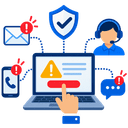
Evaluate whether employees correctly identify and report suspicious activities through established channels, helping improve early detection and response.
Reduce Phishing & Fraud Risk
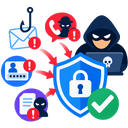
Identify susceptibility to phishing, vishing, impersonation, credential theft, and other social engineering tactics before they result in real security incidents.

Build a Stronger Security Culture
Encourage security-conscious behaviour across departments and reinforce employees’ role as an important layer of defence against cyber threats.

Improve Employee Awareness
Give employees practical exposure to realistic attack scenarios, helping them recognise suspicious requests, verify information, and respond more securely.

Support Compliance & Audit Readiness
Frequently Asked Questions (FAQs)
1. What is Social Engineering Testing ?
Social Engineering Testing is a controlled security assessment that simulates real-world deception techniques to evaluate how employees recognise, respond to, and report potential attacks such as phishing, vishing, credential harvesting, and other social engineering threats.
2. What types of social engineering attacks can be tested ?
Testing can include email phishing, voice phishing (vishing), WhatsApp phishing, credential capture, email spoofing, malware delivery simulations, USB simulations, fake mobile applications, reconnaissance, observation, and tailgating, depending on the agreed scope.
3. Will employees know they are being tested ?
This depends on the objectives of the engagement. Testing may be conducted covertly to measure natural employee behaviour or with prior awareness where appropriate. The approach and target groups are agreed with authorised stakeholders before testing begins.
4. Is Social Engineering Testing safe for our employees and systems ?
Yes. All simulations are conducted in a controlled and authorised manner within an agreed scope. Testing scenarios are designed to measure employee behaviour and security awareness without introducing unnecessary risk or disrupting normal business operations.
5. What will we receive after the assessment ?
You will receive a comprehensive report covering campaign results, employee interaction metrics, identified human-risk areas, department-level insights, successful attack scenarios, and actionable recommendations to improve awareness, processes, and security controls.
6. How often should Social Engineering Testing be conducted ?
Why Choose Condition Zebra
Local cybersecurity expertise backed by realistic social engineering scenarios, experienced security professionals, multi-channel testing, measurable behavioural analysis, and actionable awareness recommendations to help organisations identify human vulnerabilities, reduce social engineering risk, and strengthen employee security behaviour.

Social Engineering Testing Expertise
Experienced cybersecurity professionals conducting realistic assessments across email phishing, vishing, WhatsApp phishing, credential capture, email spoofing, malware simulations, physical social engineering, and other human-focused attack scenarios.

Realistic & Targeted Simulations
Design controlled social engineering scenarios based on your industry, workforce, threat profile, and business environment to realistically evaluate how employees respond to deception and manipulation techniques.

Multi-Channel Testing
Assess employee awareness across multiple attack channels, including email, voice, messaging, web, mobile, removable media, and physical environments, providing broader visibility into human-related security risks.

Measurable Human Risk Insights
Analyse employee interactions, reporting behaviour, information disclosure, credential submissions, and other defined actions to identify vulnerable behaviours, high-risk groups, and opportunities for improvement.

Trusted Security Partner